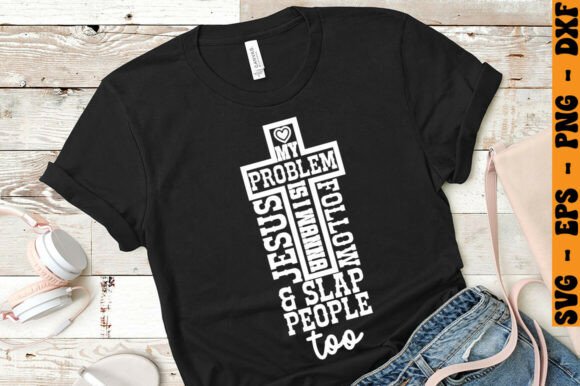
My Problem Is I Wanna Follow Jesus Sla
A Designer’s First Look: Honest, Not Hyped
When My Problem is I Wanna Follow Jesus Sla landed in my inbox, I paused—not because it’s flashy, but because it carries weight. The phrase lands with quiet sincerity, not preachy rigidity. Visually, it reads as clean, centered, and slightly conversational—like handwritten journal ink softened into stitchable form. There’s no ornate border, no heavy script flourishes, no distracting icons. Just clear, legible lettering with gentle spacing and a subtle rhythm in the line breaks. It feels like something you’d stitch on a soft cotton tote for Sunday school volunteers—or embroider onto a linen tea towel for a pastor’s anniversary gift. That grounded, approachable tone is its strongest asset.
Fits Like a Well-Worn Favorite: Where This Design Earns Its Keep
I tested My Problem is I Wanna Follow Jesus Sla on three real projects: a medium-weight unstructured canvas tote, a 100% cotton crewneck sweatshirt, and a lightweight baby onesie (size 6–12 months). On the tote, it stitched cleanly at 4.5" wide—no thread nesting, no skipped stitches. The letterforms held shape beautifully with standard polyester thread and medium tear-away stabilizer. On the sweatshirt? A little more care was needed—light cut-away stabilizer underneath kept the knit from puckering, and the design stayed crisp without looking stiff or over-engineered. Even on the delicate onesie, it read clearly when scaled to 3.25", though I did reduce density slightly in the inner curves of the “S” and “J” to avoid stiffness against baby skin.
This isn’t a design that shouts—it invites. That makes it ideal for boutique merchandise where subtlety builds trust: think aprons for Christian coffee shops, pillow covers for nursery decor, or embroidered patches sewn onto denim jackets for youth group retreats. As a T-Shirt Designs asset, it works best on relaxed-fit tees (not tight performance blends), especially in natural fibers where breathability supports the message’s warmth. Etsy sellers will find it resonates strongly in curated collections—paired with minimalist cross motifs or botanical borders—but it stands powerfully alone, too.
Where to Pause—and Why
My Problem is I Wanna Follow Jesus Sla doesn’t love every surface. Avoid it on highly textured fabrics like bouclé or thick terry cloth—the lettering loses definition in the pile. It also struggles on ultra-thin rayon or slippery poly-blends unless you add a light film-type stabilizer and slow your machine speed. Curved surfaces like structured caps? Possible—but only if you’re using a cap frame and reduce width to under 3.75". Tiny corners (like the inside of the “a” or tail of the “y”) can get muddy on dense fill stitch; check those in your embroidery software before sending to hoop.
Dark fabric demands thoughtful thread choice—navy or charcoal thread on black fabric won’t read. Stick to high-contrast options: white, ecru, or light gray for maximum clarity. And while it’s gentle enough for baby items, skip it on garments meant for frequent hot washes unless you’ve confirmed the stitch density allows for durability without stiffness. Over-stabilizing here backfires: it turns a heartfelt phrase into something rigid and impersonal.
What It Does for Your Craft Business—Beyond the Stitch
As an embroidery designer and small shop owner, I pay attention to how a design shapes perception. My Problem is I Wanna Follow Jesus Sla elevates handmade presentation because it feels intentional—not mass-produced or algorithmically generated. Customers notice that. When used on personalized gifts (like a custom sweatshirt for a baptism or graduation), it reads as sincere, not generic. That builds trust, especially among faith-based buyers who value authenticity over polish.
For Etsy sellers and craft fair vendors, this design strengthens brand consistency when paired with cohesive color palettes—think oatmeal, slate, and cream—and simple product photography. It also performs well in printable mockups: the clean lines translate clearly in grayscale previews, helping buyers visualize it on their own products before purchase. As a digital embroidery file, it encourages repeat use—not just as a standalone, but as part of a themed set (e.g., paired with “He Is Risen” or “Grace Upon Grace”). Just remember: if you plan to sell finished products featuring My Problem is I Wanna Follow Jesus Sla, verify licensing terms first. Some versions allow commercial use; others don’t. Don’t assume.
Practical Notes Every Embroiderer Should Run Through
- Always test on scrap fabric first—especially if using stretchy, textured, or dark materials.
- Check thread color contrast on both light and dark backgrounds before stitching your final piece.
- Review stitch density in your editing software—look for overly dense areas that could cause fabric distortion or stiffness.
- Confirm hoop size compatibility; this design scales well, but going below 3" risks losing legibility in smaller letters.
- Inspect small details like inner counters and connecting strokes—they’re where subtle adjustments make the biggest difference.
- Test in black-and-white mockups to assess readability without color bias.
- Use proper stabilizer: medium tear-away for stable wovens, light cut-away for knits, and film-type for slippery fabrics.
- Verify licensing before using in client work, wholesale orders, or digital product listings.
Final Thought: A Quiet Design With Real Resonance
My Problem is I Wanna Follow Jesus Sla won’t win awards for complexity—but it doesn’t need to. Its strength is clarity, sincerity, and adaptability across real-world embroidery projects. It fits naturally into faith-centered craft businesses, personalized gifting, and small-batch apparel without demanding special treatment or expensive hardware. It’s the kind of machine embroidery design that reminds us why we stitch in the first place: to make meaning tangible, one careful line at a time. Use it thoughtfully, test it honestly, and let the message speak for itself.